

17 min read

What Buyers Look for in a Roofing Business Before Making an Offer

Written by Updated October 6, 2026
Picture of Joseph Steigman
Joseph Steigman

Joe Steigman is the Founder of Legacy Entrepreneurs, a boutique business brokerage and exit advisory firm focused on helping business owners maximize value and transition their companies with confidence. With a background that combines operational leadership, corporate consulting, finance, and entrepreneurship, Joe brings a practical, owner-focused perspective to business sales and acquisitions. Joe is a Certified Business Intermediary (CBI), a designation awarded by the International Business B...

What Buyers Look for in a Roofing Business Before Making an Offer

Buyers look for a roofing business with verifiable earnings, dependable revenue, diversified customers, stable crews, capable management, and operations that can continue after the owner leaves. They also pay close attention to customer concentration, owner dependence, job costing, warranty exposure, and working-capital needs.

Those factors matter because buyers are trying to judge how reliably the business will perform after closing. A profitable roofing company can still raise concerns if its financial records are difficult to verify, one person controls too many critical functions, or key customer and employee relationships may not transfer cleanly.

Roofing Contractor’s 2026 State of the Roofing Industry Report found that 78% of contractors expect sales volumes to increase in 2026, while 89% expect growth over the next three years. In a market where contractors remain broadly optimistic about demand, buyers still need evidence that a roofing business has the financial quality, people, and systems to support that growth under new ownership.

💡 TL;DR: What Buyers Look for in a Roofing Business

  • Verifiable Earnings: Buyers want financial performance they can reconcile to tax returns, financial statements, job records, and supporting documentation.

  • Predictable Revenue: Repeat customers, visible backlog, stable lead sources, and recurring service work make future revenue easier to underwrite.

  • Diversified Exposure: Heavy dependence on one customer, salesperson, referral source, carrier, or market can weaken buyer confidence.

  • Low Owner Dependence: Buyers look for businesses where sales, estimating, production, and key relationships can continue without the seller.

  • Strong Management and Crews: Capable managers, estimators, foremen, and stable crews reduce transition risk.

  • Reliable Operating Systems: Clear job costing, scheduling, CRM processes, WIP reporting, and financial controls make the business easier to evaluate.

  • Manageable Transaction Risk: Buyers will review warranties, claims, licensing, insurance, contracts, and working-capital needs during due diligence.

  • Credible Growth Potential: Buyers give more weight to growth supported by real demand, available capacity, and proven systems than to projections alone.


What Buyers Look for in a Roofing Business: 8 Key Areas

Buyers look at more than revenue and profit. They want to understand how reliable the earnings are, where the revenue comes from, how dependent the company is on specific people or relationships, and whether the business can continue performing after ownership changes. Those questions shape the buyer’s view of risk long before a deal reaches the closing table.

1. Verifiable Earnings and Financial Performance

A buyer wants to know whether the earnings being presented are accurate, repeatable, and supported by the company’s records.

That usually means reviewing tax returns, financial statements, gross margins, job costing, and documentation for any add-backs. Smaller owner-operated roofing businesses may be evaluated using SDE, while larger companies with management in place are more often reviewed using EBITDA or adjusted EBITDA.

Add-backs can become a problem when they are poorly documented or when the expense will still exist after closing. For example, if the owner manages sales or production, a buyer may need to account for the cost of replacing that role.

What Buyers Review What They Want to Confirm
Financial statements and tax returns Reported earnings are consistent
Gross margins and job costing Profitability is supported by the work
Add-backs Adjustments are legitimate and documented
Multi-year results Earnings are not driven by one unusual year
Owner compensation Replacement costs are accounted for

Clean, well-supported financials make the business easier to evaluate and give the buyer a firmer basis for the rest of the diligence process. When records are inconsistent, add-backs are aggressive, or reported margins are hard to reconcile, the buyer may start questioning how much of the stated performance is truly sustainable.

Owners who want to understand how these financial, operational, and risk factors translate into a defensible value range can use Legacy ETA’s Roofing Business Valuation process to establish a clearer baseline before buyer discussions begin.

Read More: What is My Roofing Business Worth in 2026?

2. Revenue Quality and Predictability

After confirming the earnings, buyers want to understand how the roofing business generates its revenue and how much of that revenue is likely to continue. They will look at the mix of residential, commercial, service, new construction, and storm-related work because each carries a different level of visibility and risk.

Revenue Score What Buyers Look For Main Question
Residential Roofing Consistent lead flow, close rates, referral activity Can demand be reproduced without the seller?
Commercial Roofing Backlog, repeat accounts, project margins How dependable are the customer relationships?
Service Maintenance Repeat work, service contracts, retention How much revenue is recurring?
New Construction Builder or GC relationships, margins, pipeline Is revenue concentrated or margin-sensitive?
Storm and Insurance Work Historical consistency, market exposure How much revenue depends on weather events?

Consider a roofing company that generated unusually strong revenue after a major hail event. The results may be legitimate, but a buyer will usually separate that event-driven work from the company’s normal operating performance. By comparison, a smaller service division producing consistent maintenance revenue may receive more attention because its future demand is easier to assess.

The same logic applies to residential roofing. Buyers do not need every customer to be recurring, but they do want to see a repeatable system for creating new business. Reliable referral channels, measurable marketing performance, documented close rates, and a sales team that functions without the owner can make residential revenue easier to understand.

For roofing business owners, the useful exercise is to separate repeatable revenue from revenue created by unusual conditions. A buyer will make that distinction during diligence, so understanding it beforehand gives the owner a more realistic view of how the company’s revenue mix will be perceived.

Read More: How Roofing Companies Can Add $1 Million in Sales Without Breaking the Business

3. Customer and Lead-Source Concentration

A roofing business can appear diversified and still carry meaningful concentration risk. Buyers will usually look at both who the revenue comes from and how new work enters the company.

Concentration can show up in several ways. A commercial roofer may depend heavily on one general contractor or property manager. A residential company may serve hundreds of homeowners but still rely on one salesperson, referral partner, or paid lead channel for most new work. Geographic concentration can create a similar issue, especially when recent growth has been tied to one market or storm event.

The practical question is:

If one important customer or lead source disappeared, how quickly could the business replace that revenue?

That answer matters because concentration affects how exposed the company is to a sudden drop in sales. A buyer may be comfortable with a large customer if the relationship is long-standing and the company has a healthy pipeline behind it. The same level of concentration can feel much riskier when the account is tied personally to the owner or when there is no clear replacement source.

For owners, the useful step is to measure concentration before a buyer does. Reviewing revenue by customer, salesperson, referral source, and lead channel gives a clearer picture of where the business is resilient and where one lost relationship could create a noticeable gap.

4. Owner Dependence

Owner dependence becomes a buyer concern when too many important decisions, relationships, or revenue-producing activities still run through the seller. The issue is not how involved the owner is. It is how much of the company’s performance depends on that person remaining in place after closing.

Area Lower Owner Dependence Higher Owner Dependence
Sales The sales team manages the pipeline and follow-up Owner closes major opportunities
Operations Managers handle scheduling, production, and routine problems Owner is pulled into daily decisions
Relationships Customers and suppliers know the broader team Key relationships belong personally to the owner
Leadership Managers have clear authority Important decisions wait for the owner

The 60-Day Test

A practical way to gauge owner dependence is to ask:

If the owner stepped away for 60 days, what would keep moving and what would stall?

Look at the parts of the business that matter most: sales, estimating, production, customer communication, hiring, and day-to-day decision-making.

If those functions continue without constant seller involvement, the business is easier for a buyer to understand and transition. If estimates stop, production issues pile up, major customers lose their main point of contact, or routine decisions still require the owner, that signals a deeper dependency.

That dependency can also affect the economics of a deal. If the owner is effectively filling the role of a general manager, sales leader, or senior estimator, the buyer may need to account for the cost of replacing that work after closing.

For an owner preparing to sell, the practical goal is to move critical responsibilities into the company before a transaction begins. Buyers are generally more comfortable when the business has clear ownership of sales, operations, customer relationships, and day-to-day decisions beyond the seller.

Read More: 5 Things That Actually Drive Your Roofing Company's Sale Price (and 3 That Don't)


5. Management Depth and Key Employees

A roofing business can be less dependent on the owner and still carry significant key-person risk. Buyers will look at who actually keeps the company running, how responsibilities are distributed, and what would happen if one important employee left after closing.

The strongest management teams usually have clear ownership across the major functions of the business: sales, estimating, production, finance, scheduling, and customer service. Buyers will also pay attention to whether those managers have real decision-making authority or still rely on the seller for approval.

Who Would Be Difficult to Replace?

Rather than focusing only on job titles, identify the people whose departure would materially affect the company. That could be:

  • A production manager who coordinates every crew and subcontractor

  • An estimator who understands most commercial accounts and pricing history

  • A salesperson responsible for a large share of new revenue

  • A foreman who holds critical field knowledge

  • An office manager who controls billing, collections, and customer communication

A buyer will want to understand what each person does, whether anyone else can perform that work, and how likely the employee is to remain through an ownership transition.

For example, a roofing company may have a general manager in place, but if the owner still handles every major customer issue and the senior estimator is the only person who understands commercial pricing, the management structure is thinner than the org chart suggests.

Strong management depth means important knowledge, authority, and customer relationships are spread across the organization. That gives a buyer more confidence that losing one person will not disrupt the company’s ability to sell, produce, and collect on its work.

6. Workforce Stability and Production Capacity

For roofing buyers, the workforce question is practical:

Can the company keep completing jobs at the same pace and quality after the sale?

That means looking beyond headcount. Buyers will want to understand how stable the crews and foremen are, how much the company relies on subcontractors, how often production roles turn over, and whether too much field knowledge sits with one person or one crew.

They will also pay attention to whether the business has enough experienced labor to support the sales pipeline. A growing roofing company can have strong demand and still create concern if production is constantly constrained or if the backlog depends on a small number of reliable installers.

Safety history matters here too. Buyers may review training practices, workers’ compensation claims, and other indicators that show whether the workforce is being managed consistently.

For example, a residential roofing company may have plenty of signed work, but if only one crew can handle complex installations, the backlog may be more fragile than it appears. In a commercial operation, the same issue can show up when one foreman or project manager carries most of the operational knowledge.

The stronger position is a workforce that is stable, sufficiently staffed, and not overly dependent on one crew, one foreman, or constant owner intervention. That gives the buyer more confidence that current jobs and future growth can be delivered without disruption.

7. Operational Systems and Documentation

Buyers want to understand how work moves through the roofing business from the first lead to the final invoice and any warranty follow-up. Clear systems make that process easier to verify and reduce reliance on individual memory.

Stage What Buyers Review What They're Testing Risk If It's Weak
Lead CRM records, lead sources, response times, follow-up process Whether demand generation is repeatable and measurable Revenue may depend on the owner, one salesperson, or one channel
Estimate Pricing process, estimating methods, approvals, historical win rates Whether jobs are priced consistently and margins are intentional Inconsistent pricing or weak estimating can distort profitability
Job Scheduling, production workflow, job costing, change orders Whether work is completed efficiently and margins are tracked accurately Poor execution can hide margin leakage and capacity issues
Billing WIP reporting, invoicing, collections, retainage Whether revenue converts into cash predictably Weak collections or unclear WIP can create working-capital pressure
Warranty Warranty records, open claims, callbacks, service history Whether post-job obligations are documented and manageable Unclear warranty exposure can create future cost and liability

Job costing is especially important. A roofing company can report strong overall margins while certain job types, crews, or customer segments consistently underperform. Reliable job-level reporting helps a buyer see where the profit is actually coming from.

Backlog is another area where documentation matters. Buyers may want to confirm which jobs are signed, expected margins, projected start dates, material commitments, and whether the current production team has enough capacity to complete the work.

The goal is not to document every task. Buyers want enough visibility to understand how the company operates, how performance is measured, and whether those processes can continue after the seller leaves.

8. Transferability and Transaction Risk

Once buyers understand the company’s financial performance, revenue quality, people, and systems, they turn to a more practical question:

What exactly carries over to the new owner, and what could become a problem after closing?

This part of diligence matters because some of the biggest transaction risks are not obvious from the income statement. Licensing, warranties, contracts, working capital, and unresolved obligations can all affect how smoothly the business transfers and how comfortable a buyer feels moving forward. Buyers will usually focus on a few areas:

  1. Licensing and Insurance: Buyers want to confirm which licenses are required, who holds them, and whether they will remain valid after the sale. They may also review insurance coverage, claims history, and any unresolved issues that could create continuity or liability concerns.

  2. Warranties and Open Claims: Roofing companies can carry obligations long after a project is completed. Buyers may review workmanship warranties, callbacks, active claims, and historical repair costs to understand what exposure may continue after closing.

  3. Contracts and Key Relationships: Customer agreements, supplier relationships, leases, referral sources, and commercial accounts may all need to transfer. Buyers will want to know which agreements require consent and which relationships depend heavily on the seller personally.

  4. Working Capital Requirements: A profitable roofing company can still require significant cash to fund payroll, materials, and ongoing jobs. Buyers will look at receivables, payables, inventory, and normal operating needs to understand how much capital the business requires after closing.

  5. WIP and Retainage: For commercial roofing companies, buyers may review work-in-progress schedules, earned revenue, remaining costs, billing status, and retainage. Weak visibility in these areas can make project profitability and cash collection harder to assess.

  6. Liabilities That May Survive the Sale: Pending disputes, safety issues, employee obligations, lease commitments, and other unresolved matters can affect how comfortable a buyer is proceeding with the transaction.

The strongest position is a business where these obligations are already documented and understood before diligence begins. That gives the buyer a clearer picture of what they are inheriting and reduces the chance that a late discovery disrupts the transaction. For the seller, the practical takeaway is simple:

Transferability is easier to defend when licenses, agreements, claims, warranties, and working-capital needs are organized well before an offer is on the table.

Read Next: What It's Really Like to Sell a Roofing Business

What Can Make Buyers More Cautious During Due Diligence?

A buyer may be comfortable enough with a roofing business to submit an offer and still change their view once deeper diligence begins. That usually happens when the records reveal risks or dependencies that were not fully reflected in the information used to make the initial offer.

The most important diligence issues are usually the ones that affect sustainable earnings, operational continuity, or the buyer’s understanding of what they will inherit after closing.

What the Buyer Finds Why It Raises Concern What It Can Lead To
Financials that do not reconcile Tax returns, internal statements, or reported earnings tell different stories More financial review and questions about earnings quality
Unsupported add-backs Adjustments cannot be documented or represent costs that will continue Lower accepted adjusted earnings
Weak job costing The buyer cannot confirm which projects or service lines are actually profitable Greater scrutiny of gross margins and historical performance
Unreliable backlog Signed work, margins, timing, or production requirements are unclear Less confidence in projected revenue
High customer or lead concentration Too much revenue depends on a small number of customers or lead sources
More concern about future cash flow
Heavy owner dependence Critical functions may not continue when the seller leaves Replacement costs or a more involved transition plan
Key employee risk An important manager, estimator, salesperson, or foreman may leave Retention planning and greater operational uncertainty
Warranty or claims exposure Future obligations are difficult to quantify Additional diligence or negotiated protections
Working-capital surprises The company requires more cash to operate than the buyer expected Changes to closing mechanics or working-capital negotiations

None of these findings automatically ends a transaction. Buyers regularly acquire companies with identifiable risks when those issues can be understood, quantified, and addressed.

The harder situation is when an important issue appears late or contradicts something the buyer previously relied on. That can create questions beyond the issue itself because the buyer may begin wondering what else has not surfaced.

For roofing business owners, preparation means identifying these issues before diligence starts and having the records needed to explain them. A known concentration issue, documented warranty exposure, or clearly supported add-back is much easier for a buyer to evaluate than a surprise discovered after the letter of intent.

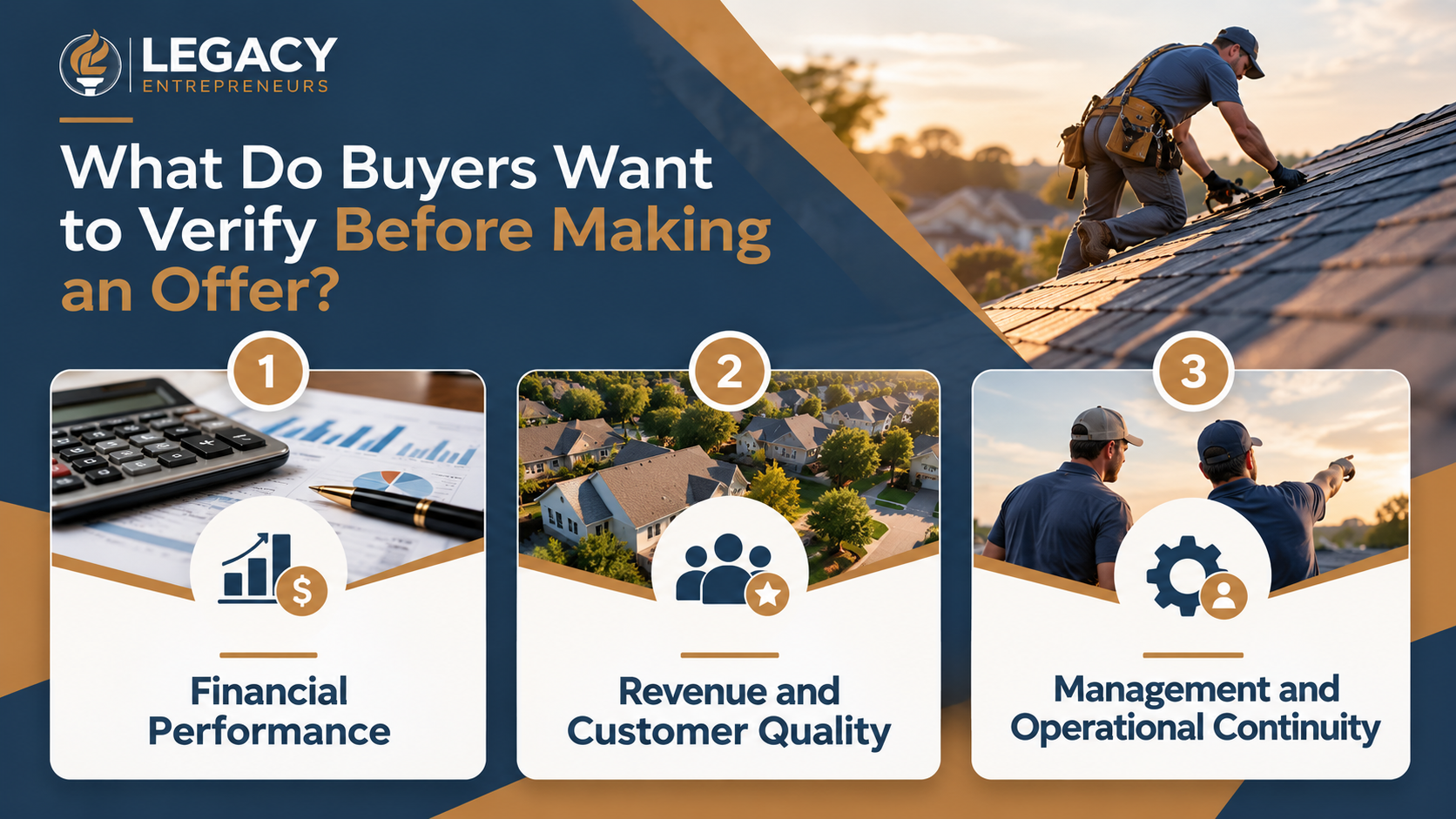
What Do Buyers Want to Verify Before Making an Offer?

Before making an offer, buyers usually want enough evidence to decide whether the roofing business is worth pursuing and whether the initial financial story holds together. They are not completing full due diligence yet, but they are testing the assumptions that will shape an LOI.

A practical way to think about this stage is in three buckets:

Financial Performance

Buyers may review several years of revenue, profitability, gross margins, and adjusted earnings to see whether performance is stable and whether recent results are representative.

They will also want a high-level explanation of any add-backs, unusual expenses, or major swings in performance. If the numbers require too much interpretation before an offer is even made, that can slow momentum.

Revenue and Customer Quality

A buyer will usually want to understand where revenue comes from and how much of it is concentrated. That may include:

  • Revenue by customer

  • Residential vs. commercial work

  • Service and maintenance revenue

  • Backlog

  • Lead sources

  • Customer concentration

  • Storm-related revenue

  • Geographic mix

The goal is to determine how much of the current revenue base appears repeatable.

Management and Operational Continuity

Buyers will also want a basic understanding of who runs the business and what changes when the owner leaves.

That often means reviewing the organizational structure, the owner’s current responsibilities, key managers, production leadership, workforce stability, and whether the company has enough systems in place to operate through a transition.

At this stage, buyers are deciding whether they have enough confidence to move forward. The deeper verification usually comes after an LOI, but the quality of the information shared before the offer can influence how comfortable the buyer feels making one in the first place.

How Buyers Think About Growth Potential

Buyers will pay attention to growth, but they usually separate proven momentum from opportunities that still depend on future execution.

A roofing business with an established commercial maintenance program, a growing backlog, or a sales team already producing results gives a buyer something concrete to evaluate. A business that “could expand into commercial work” or “could open another market” may still have upside, but the buyer is less likely to give full credit to growth that has not been demonstrated. A useful way to think about growth is in three levels:

  1. Proven Growth: The company is already showing measurable improvement in revenue, margins, recurring work, or market share.

  2. Supported Opportunity: The business has evidence that an opportunity exists, such as signed service contracts, active demand in an adjacent market, or unused production capacity.

  3. Speculative Upside: The opportunity may be real, but it still requires the buyer to provide new capital, hire people, build systems, or create demand after closing.

For example, a roofing company that has already added commercial maintenance customers and can show repeat service revenue presents a stronger growth case than one that simply plans to launch a maintenance division someday.

The same applies to geographic expansion. Existing customers, referral activity, or a working sales pipeline in a nearby market gives the buyer more evidence than a broad claim that the territory is attractive.

Buyers generally respond best when growth can be tied to current performance, available capacity, and real customer demand. The more work the buyer has to do to create the opportunity, the less likely they are to treat that upside as part of the company’s existing value.

Read More: Why Private Equity Is Buying Roofing Companies

Do Different Roofing Business Buyers Look for Different Things?

Yes. Most buyers care about earnings quality, transferability, and risk, but they may weigh those factors differently depending on how they plan to own and operate the business.

An Individual Buyer may focus more heavily on cash flow, owner responsibilities, and how much day-to-day involvement the business requires. If they expect to step into the seller’s role, the transition plan and SDE can matter more.

A Strategic Roofing Buyer may care more about geographic fit, crews, customer relationships, service lines, and whether the company adds capacity or capabilities they already understand how to operate.

A Private Equity-Backed Buyer or Regional Platform may place greater emphasis on adjusted EBITDA, management depth, financial reporting, repeatable systems, and whether the business can continue growing without the seller.

That difference matters when evaluating buyer interest. The same roofing company may look attractive for different reasons to different buyers, and the areas they scrutinize most closely can change with their acquisition strategy.

For owners, the practical takeaway is to understand which parts of the business are likely to matter most to the buyer sitting across the table. The strongest fit is usually the buyer whose operating model, growth plans, and expectations align with how the company already performs.

Read More: Who is Buying Roofing Companies in Tennessee? A Guide to Finding the Right Buyer

How Can Roofing Business Owners Prepare for Buyer Scrutiny?

Preparation is most useful when it happens before a buyer starts asking for documents. That gives the owner time to fix weak reporting, clarify dependencies, and organize information without the pressure of an active deal.

A good starting point is to review the business the way a buyer will. That means checking whether the financial records reconcile, whether add-backs are documented, whether customer and lead-source concentration is understood, and whether the owner’s role is clearly defined.

The same review should extend into operations. Buyers will want to see whether job costing is current, backlog is reliable, key managers can operate independently, and licenses, insurance, warranties, contracts, and claims records are organized. One practical approach is to work through four questions:

  1. Can the earnings be verified? Make sure tax returns, financial statements, job-costing reports, and supporting records tell a consistent story.

  2. Can the business operate without the owner? Identify which responsibilities still depend on the seller and who would take them over after closing.

  3. Can the buyer understand the risks quickly? Document concentration, claims, warranty exposure, working-capital needs, and any key-person dependencies before diligence begins.

  4. Can the company support its current growth story? Confirm that backlog, staffing, sales capacity, and operating systems support the performance being presented.

The goal is not to make the company look perfect. Buyers expect to find risks. What matters is whether those risks are known, documented, and manageable before they become surprises during diligence. For owners moving from preparation into an actual transaction, Our Process at Legacy ETA explains how valuation, sale preparation, buyer outreach, offer evaluation, due diligence, and closing fit together.

Read Next: How to Sell Your Roofing Company in Tennessee: Positioning the Business for a Smoother Sale

Buyer Confidence Is Built Before the Deal Starts

By the time a buyer reaches serious diligence, most of the important questions have already been shaped by the company’s financial history, customer mix, management structure, workforce, and operating discipline. Owners have far more control over those factors before a transaction begins than they do once a buyer is actively testing them.

A roofing business is easier to evaluate when the earnings are supportable, revenue sources are understandable, responsibilities are distributed across the team, and the major risks are already documented. That gives the buyer a clearer view of what they are acquiring and reduces the number of assumptions that have to be made during the process.

Key Takeaways

  • Financial credibility matters early. Clean records and defensible earnings make the initial evaluation easier.

  • Revenue quality matters alongside revenue size. Buyers want to understand how repeatable the work really is.

  • Concentration and owner dependence create transaction risk. Both can affect how confidently a buyer views future performance.

  • Management and workforce continuity matter after closing. Strong people reduce the disruption associated with an ownership change.

  • Operational visibility supports diligence. Reliable job costing, backlog reporting, and documented processes help buyers verify how the company performs.

  • Known issues are easier to manage than surprises. Problems tend to become more difficult when they surface late in the process.

For roofing business owners considering a sale, the next useful step is to assess the company from the buyer’s perspective before going to market. Legacy ETA’s Roofing Sellability Tool can help identify areas such as owner dependence, management depth, operational transferability, and other factors that may affect buyer confidence.

Find Out How a Buyer May View Your Roofing Business


Frequently Asked Questions

How Do Buyers Compare Commercial vs. Residential Roofing Companies?

Buyers evaluate commercial and residential roofing companies differently because the revenue models, customer relationships, project cycles, and operational risks are different. Commercial roofing may offer repeat accounts, maintenance revenue, longer backlogs, and service contracts, while residential roofing may depend more heavily on lead generation, sales conversion, referral activity, and local market demand.

For a buyer, neither model is automatically better. The stronger company is usually the one that can show consistent profit margins, reliable demand, manageable customer concentration, and a sales process that can continue after the owner leaves.

How Do EBITDA and Adjusted EBITDA Affect Buyer Evaluation?

EBITDA gives buyers a starting point for understanding the operating earnings of larger roofing companies, while adjusted EBITDA accounts for legitimate nonrecurring or owner-specific expenses. Buyers will review those adjustments closely because they affect the amount of sustainable cash flow they believe the company can produce after closing.

During the sale of a roofing business, aggressive or poorly documented adjustments can create problems during diligence. Buyers generally give more weight to earnings that are supported by clean financial records and expenses that can be clearly explained.

Why Does Working Capital Matter When Selling a Roofing Business?

Working capital helps determine how much cash the company needs to continue paying employees, suppliers, and other operating expenses while waiting for customers to pay. This can be particularly important for commercial roofing companies that carry significant accounts receivable, WIP, or retainage.

A buyer evaluating a roofing business for sale will usually want to understand the company’s normal working-capital requirements before closing. If the business routinely needs substantial cash to fund projects, that requirement can become part of the transaction negotiations.

How Important Is Recurring Revenue to Roofing Business Buyers?

Recurring revenue can make future cash flow easier for buyers to evaluate because there is evidence that some customer demand will continue. In the roofing industry, that may include commercial maintenance programs, service contracts, inspection programs, or repeat work from established accounts.

Roofing companies often have a mix of recurring and project-based revenue, so buyers do not expect every dollar to repeat automatically. They will usually focus on how dependable the revenue base is and whether the company has a consistent process for replacing completed work with new jobs.

What Common Mistakes Can Reduce Buyer Confidence in a Roofing Business?

Common mistakes include waiting until diligence to organize financial records, presenting unsupported add-backs, overlooking customer concentration, relying too heavily on the owner, and failing to document job costing, warranties, claims, or key operating processes.

Owners who want to sell can usually improve the process by identifying those issues before the company goes to market. Addressing weaknesses early does not guarantee buyers pay more, but it can make the company easier for a buyer to evaluate and reduce avoidable questions once a transaction is underway. For owners who need help identifying those issues, sell-side advisory services can also provide an outside review before buyer discussions begin.

What Buyers Look for in a Roofing Business Before Making an Offer

What Buyers Look for in a Roofing Business Before Making an Offer

Buyers look for a roofing business with verifiable earnings, dependable revenue, diversified customers, stable crews, capable management, and...


Read More
How to Value a Roofing Company Beyond the Multiple

How to Value a Roofing Company Beyond the Multiple

To value a roofing company, start with normalized SDE or EBITDA, then assess earnings quality, the risks attached to them, and how well the business...

Read More
Someone Wants to Buy My Roofing Company. Is the Offer Good?

Someone Wants to Buy My Roofing Company. Is the Offer Good?

Someone wants to buy your roofing company. Whether the offer is good depends on much more than the purchase price. You need to know what your company...

Read More